
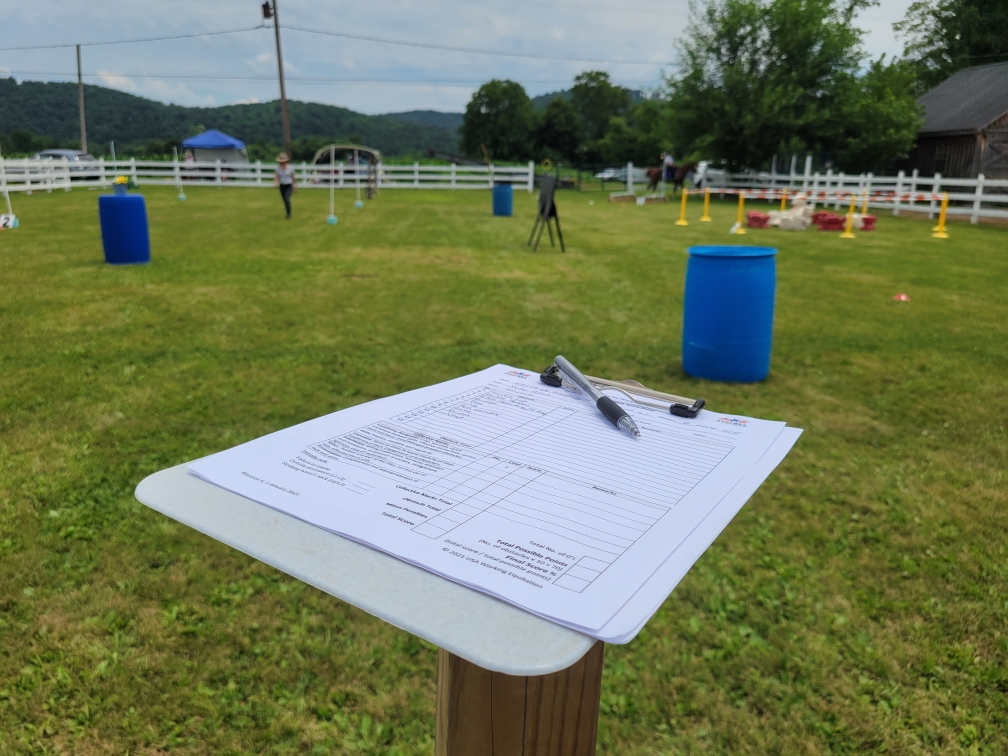
The Ease of Handling (EOH) trial is a critical component of Working Equitation competitions, requiring a harmonious blend of precision and partnership between horse and rider. As the competition’s second phase, EOH is mandatory across all performance levels, from Introductory to Masters, challenging riders to demonstrate their ability to navigate a course of obstacles with fluidity, control, and strategic planning. This article delves into the multifaceted approach necessary to master the EOH trial, encompassing both effective memorization and seamless execution.
To ensure accuracy and adherence to the latest standards, it is essential to consult the most recent edition of the United States Rules for Working Equitation (Rulebook), specifically SECTION 6. EASE OF HANDLING (EOH) TRIAL and APPENDIX B – OBSTACLES. In the event of any discrepancies, the Rulebook remains the definitive source of information.
Within this article, we will explore practical tips for memorizing and effectively executing the EOH trial. A unique aspect of the Ease of Handling (EOH) trial is that competitors can expect a different course design at each show. Recognizing that each course will present a distinct challenge, riders must be prepared to adapt their memorization and execution strategies. The course must incorporate a minimum number of obstacles, varying by performance level, and a course map is provided to competitors at least two hours prior to the trial. Riders are granted a designated course walk to memorize the layout and strategize their approach, underscoring the importance of quick adaptation and flexible planning.
I. Experiencing the Course: Physical Immersion & Understanding
Analyzing the Course Map: To begin mastering the EOH course, it’s essential to physically engage with the layout and develop a deep understanding of its structure. Start by thoroughly analyzing the course map, dissecting it into manageable segments like entry, transitions, obstacle clusters, and exit. Actively identify recurring patterns within the obstacles and pay close attention to distances and angles to cultivate spatial awareness. Consider annotating the map with notes on transition points, direction changes, and the specific cues you intend to use.
Walking the Course: Next, immerse yourself in the course by walking it as if you were riding, mimicking your horse’s strides and turns to internalize the physical flow. Verbalize each obstacle and the corresponding cues you’ll give your horse, reinforcing the connection between physical movement and mental recall. Pay close attention to transition points and visualize the rhythm and pacing of your ride.
Miniature Practice: Enhance this tactile learning by creating a scaled-down version of the course using small markers, effectively transforming any space into a miniature arena. Walk the course as if you were riding, mimicking your body movements and cues, and use household objects to simulate obstacles, creating a tangible and relatable practice environment.
II. Mastering the Course: Memorization & Mental Rehearsal
Detailed Visualization: Solidifying course memorization and building confidence requires a focus on mental techniques. Engage all your senses as you harness the power of detailed visualization, imagining the feel of your horse, the sounds of the arena, and the pressure of your reins. Visualize yourself giving specific cues and mentally troubleshoot potential issues. Practice visualization consistently throughout show days to reinforce the course in your mind.
Mnemonic Devices: Craft memorable stories and mnemonics, using personalized associations and vivid imagery to construct memorable narratives, ensuring logical connections and rhythmic phrases that mirror the course’s flow.
Drawing and Active Recall: Enhance recall by drawing and redrawing the course from memory, verbalizing the sequence as you sketch, and comparing your work to the official map.
Segmented Practice: Refine your execution by identifying challenging segments and practicing them repeatedly, gradually integrating mastered sections and incorporating varied practice.
Pre-Sleep Rehearsal (If applicable): Before drifting off to sleep, visualize the entire course in detail, incorporating positive affirmations.
Auditory Reinforcement: Reinforce auditory learning by recording yourself describing the course and listening to the recording during tasks that don’t require intense concentration.
Interactive Quizzing: Finally, test and sharpen your recall by engaging in varied questioning with a friend.
III. Preparing for the Unexpected: Plan B & Adaptability
Developing a Plan B: To ensure a confident and successful ride, it’s essential to prepare for the unexpected. While visualizing, actively create alternate plans for common issues that could happen during the ride. Develop a plan B for each obstacle, transition point, and potential horse nervousness or off-course moments.
Riding with Confidence: Having a plan will allow the rider to remain calm and collected, and finish the course well. By preparing for the unexpected, you will be able to ride with more confidence.
Written by Amy Star, edited by Audrey Rapp